
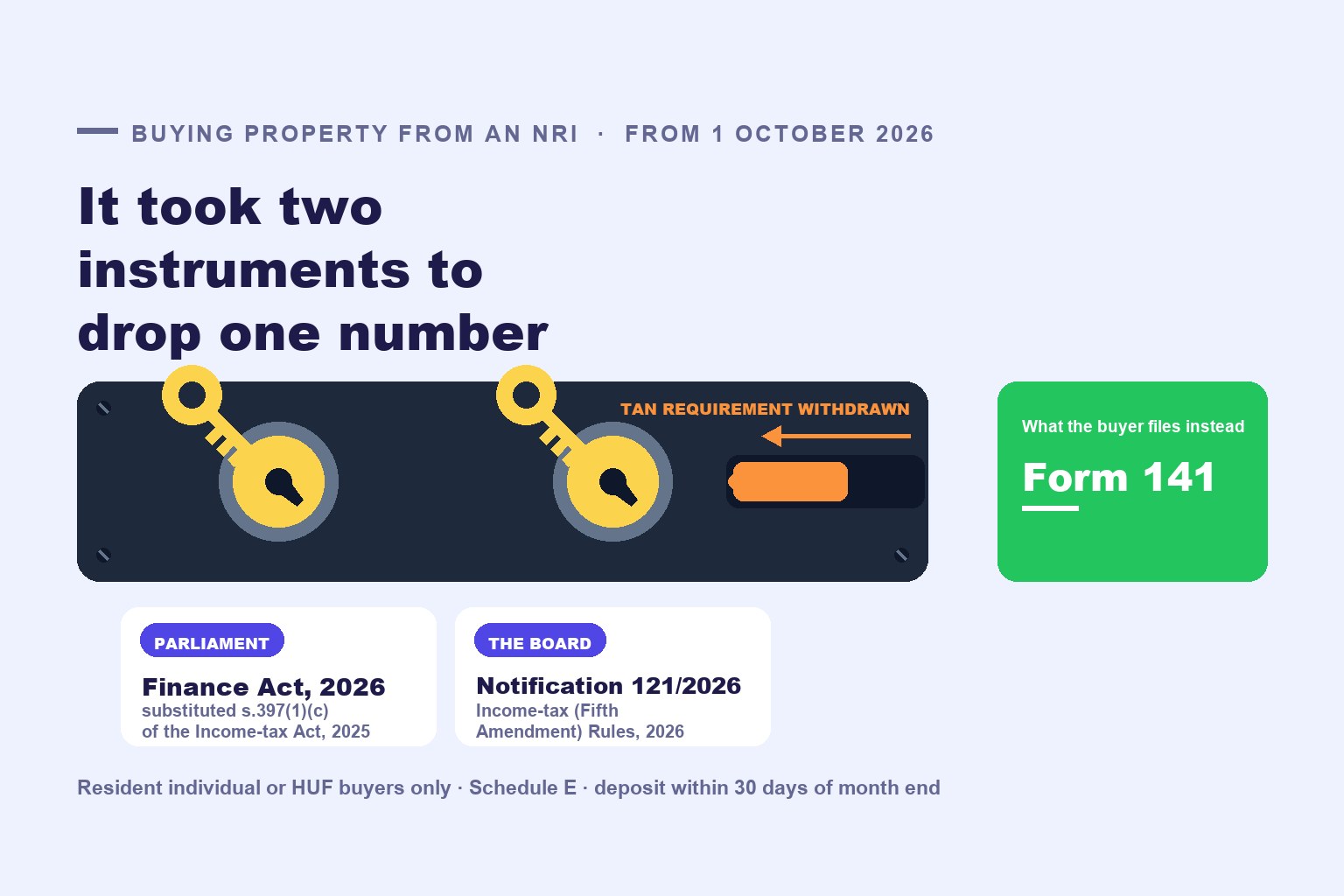

If you are a resident individual or a HUF buying a flat, a house or land from a non-resident seller, and you deduct the tax on or after 1 October 2026, you do not need a TAN. You deduct against your PAN, you deposit the tax within thirty days from the end of the month — not seven — and you report it in Form 141, the same challan-cum-statement resident-seller buyers already use, under a new Schedule E written for this transaction. Then you issue the seller a Form 132 certificate. Two things are worth getting straight before you plan around it. First, the CBDT did not remove the TAN requirement — Parliament did, by substituting section 397(1)(c) of the Income-tax Act, 2025 through the Finance Act, 2026; the notification of 22 September supplies the form that makes the relief usable. Second, and this is where deals will go wrong: the TAN is the only thing that went away. The rate is unchanged, the full-consideration base is unchanged, and the Form 145 filing — with an accountant's certificate in Form 146 once you cross Rs 5 lakh — is untouched by any of this.
1. What was actually notified, and by whom
The document everyone is reporting is Notification No. 121/2026 (F. No. 370142/29/2026-TPL), G.S.R. 830(E), dated 22 September 2026, which makes the Income-tax (Fifth Amendment) Rules, 2026. It comes into force on 1 October 2026. It amends rules 215, 218 and 219 of the Income-tax Rules, 2026, and Forms 132 and 141 in Appendix III.
Read the first line of it, because it settles the agency question that every headline gets wrong:
"In exercise of the powers conferred by section 533 read with sections 395(4)(a) and 397(3)(a) and (b) of the Income-tax Act, 2025 (30 of 2025), the Central Board of Direct Taxes hereby makes the following rules further to amend the Income-tax Rules, 2026…"
Those are rule-making powers over certificates and statements. They are not a power to switch off a statutory obligation, and the notification does not purport to. Nowhere in its four pages does the word "TAN" appear.
The TAN requirement lives in section 397(1)(a) of the Income-tax Act, 2025: every person deducting or collecting tax shall apply for allotment of a tax deduction and collection account number. The exemptions from it live in section 397(1)(c). And section 397(1)(c) was substituted by the Finance Act, 2026 (Act No. 4 of 2026), with effect from 1 October 2026 — the Department's own consolidated text of the Act carries the amending footnote and reproduces what clause (c) said before. The new clause reads:
"(c) the provisions of clause (a) shall not apply to—
(i) a person in respect of a transaction where he is required to deduct tax under section 393(1) [Table: Sl. No. 2(i), 3(i) or 6(ii)]; or
(ii) a person referred to in section 393(4) [Table: Sl. No. 12.C(a)] in respect of a transaction where he is required to deduct tax on consideration for transfer of a virtual digital asset under section 393(1) [Table: Sl. No. 8(vi)]; or
(iii) a resident individual or Hindu undivided family in respect of a transaction where he is required to deduct tax on any consideration for the transfer of any immovable property under section 393(2) [Table: Sl. No. 17]; or
(iv) a person notified in this regard by the Central Government."
Sub-clause (iii) is the relief. It is in the Act, not in the Rules.
So why did anything need notifying at all? Because a statutory exemption from holding a TAN is useless if the only way to report the deduction is a form that cannot be filed without one. Before 1 October, a deduction under section 393(2) went into the quarterly statement in Form 144 under rule 219(1) — the successor to Form 27Q — which is filed by a deductor identified by TAN. Parliament removed the requirement to hold the number; the Board had to build somewhere for a buyer without one to file. The two instruments commence on the same day and only work together. That is the whole story, and it is why "the CBDT has removed the TAN requirement" is the wrong sentence.
2. Who gets the relief — and the narrowing that came with it
The exemption is tightly drawn. Every limb of it has to hold:
- The buyer must be a resident individual or a Hindu undivided family. A company, a firm, an LLP, an AOP or a trust buying the same property gets nothing from this. Neither does a non-resident buyer.
- The deduction must be under section 393(2) [Table: Sl. No. 17] — the residual non-resident withholding entry, successor to section 195 of the 1961 Act.
- The payment must be consideration for the transfer of immovable property.
Now the part that has gone unreported. Compare the substituted clause with the one it replaced, which the footnote preserves:
"(c) the provisions of clause (a) shall not apply—
(i) to a person who is required to deduct tax under provisions of section 393(1) [Table: Sl. Nos. 2(i), 3(i) and 6(ii)];
(ii) to a person referred to in section 393(4) [Table: Sl. No. 12.C(a)]; and
(iii) a person notified in this regard by the Central Government."
Two drafting changes ride along with the new relief.
The exemption is now transaction-scoped rather than person-scoped. The old limb (i) exempted "a person who is required to deduct tax under" the listed entries. The new limb (i) exempts "a person in respect of a transaction where he is required to deduct tax under" them. On the old wording there was at least an argument that a person who made a qualifying deduction fell outside clause (a) generally. On the new wording there is none: the exemption attaches to the transaction, so a buyer who also runs a business that deducts TDS on contractor payments plainly still needs a TAN for that business. What the new wording does not settle is whether such a buyer may leave that existing number out of this transaction. Clause (c) disapplies only clause (a), the obligation to apply for a number; clause (b) separately requires a person to whom a number "has been allotted" to quote it in all challans, statements and certificates referred to in the Chapter. That is an unresolved question rather than a licence, and it is taken up in section 7.
The virtual digital asset limb has been narrowed outright. Old limb (ii) exempted a section 393(4) [Sl. No. 12.C(a)] person, full stop. New limb (ii) exempts that person only "in respect of a transaction where he is required to deduct tax on consideration for transfer of a virtual digital asset under section 393(1) [Table: Sl. No. 8(vi)]". That is a restriction, enacted in the same breath as a relief, and it is not what anyone is discussing this week.
3. The route, before and after
Here is the whole mechanism on both sides of 1 October 2026, for a resident individual or HUF buying from a non-resident seller. Every cell is from the Rules as they stand or as the Fifth Amendment substitutes them.
| Step | Deduction before 1 Oct 2026 | Deduction on or after 1 Oct 2026 |
|---|---|---|
| TAN | Required — apply in Form 135 under rule 216 | Not required — section 397(1)(c)(iii) |
| Deposit the tax by | 7 days from the end of the month of deduction (rule 218(2)(b)) | 30 days from the end of the month of deduction (new rule 218(3)(e)) |
| Reported in | Form 144, quarterly, under rule 219(1) Sl. No. 2 | Form 141 challan-cum-statement, new Schedule E, within 30 days of the month end (new rule 219(5)(e)) |
| Certificate to the seller | Form 131, within 15 days of the Form 144 due date (rule 215(1) Sl. No. 2) | Form 132, within 15 days of the Form 141 due date (rule 215(1) Sl. No. 3, as substituted) |
| Rate | Unchanged. "Rates in force" for section 393(2) Sl. No. 17 — see section 4 below | |
| Base | Unchanged. Full consideration, no threshold, unless a certificate reduces it | |
| Form 145 / Form 146 | Unchanged. Rule 220 is not touched by this notification | |
Three of those rows are a genuine and quantifiable easing that no report has picked up.
The deposit clock more than quadruples. A buyer who paid an instalment on 3 October used to have until 7 November to get the tax into the government's account. From 1 October the payment is governed instead by rule 218(3), which the Fifth Amendment opens up: its opening words now read "where any sum is deducted under section 393(1) and (2)", and a new clause (e) brings this exact transaction — consideration for the transfer of immovable property under section 393(2) [Sl. No. 17], paid or credited by a resident individual or HUF — into the list the sub-rule covers. The thirty days are in rule 218(3)'s own closing words, which apply to everything in that list: payment "within a period of thirty days from the end of the month in which the deduction is made and shall be accompanied by a challan-cum-statement in Form No. 141". Clause (e) does not set the deadline; it puts you inside it. The same 3 October deduction now has until 30 November. For a buyer juggling a registry, a bank loan disbursal and a seller's repatriation, three extra weeks is not nothing.
The seller gets the TDS certificate much sooner. This one cuts in the non-resident's favour. Under rule 215(1) Sl. No. 2, the Form 131 certificate for a section 393(2) deduction is due fifteen days after the quarterly Form 144 due date. A deduction in early April therefore produced a certificate around mid-August. Under the substituted Sl. No. 3, this deduction now takes Form 132, due fifteen days after the Form 141 due date — so roughly forty-five days after the month of deduction. An NRI seller who needs the Indian certificate to claim foreign tax credit in their country of residence gets it in a fraction of the time.
Reporting collapses from a quarterly return to a single transaction filing. Form 141 is the unified challan-cum-statement: you pay and you report in one act, per deduction, and there is no return to file afterwards. Rule 219(5) opens with "Irrespective of anything contained in sub-rule (1) or (2) or (4)", and the Fifth Amendment adds clause (e) to it for this transaction. That non-obstante is the precise mechanism by which Form 144 is displaced — you do not file Form 144 as well, and you do not file it on a PAN basis either.
4. The rate did not move, and that is where the money still is
Nothing in this notification touches what you deduct. It is worth restating because a compliance easing gets read as a tax easing.
Section 393(2) Table Sl. No. 17 covers "any interest… or any other sum chargeable under the provisions of this Act, not being income chargeable under the head 'Salaries'" paid to a non-resident, by any person, at "rates in force". There is no threshold. Unlike the resident-seller route under section 393(1) [Sl. No. 3(i)], where 1% bites only above Rs 50 lakh, a sale by a non-resident is within Sl. No. 17 from the first rupee.
"Rates in force" is defined in section 2(90)(c), and for Sl. No. 17 it means "the rate or rates of income-tax specified in this behalf in the Finance Act of the relevant tax year or the rate or rates of income-tax specified in an agreement entered into by the Central Government under section 159(1), or an agreement notified… under section 159(2), whichever is applicable". In other words the treaty rate, where one applies and its conditions are met, is built into the statutory rate for this entry rather than being something you have to go and win a certificate for.
On the domestic side the gain itself is taxed under section 197(1)(b) at 12.5% where the property is a long-term capital asset, plus the applicable surcharge and cess. A short-term gain gets no special rate at all: it goes into total income and is taxed at whatever rate applies to that seller — slab rates for an individual, the applicable rate for a foreign company — so "short-term gains at slab rates" is only right where the seller is an individual. One trap worth naming: the relief in section 197(3) — the option to compute at 20% with indexation for land or building acquired before 23 July 2024 — is available only "in the case of an individual or a Hindu undivided family, being a resident". A non-resident seller cannot use it.
And because Sl. No. 17 applies to the sum paid rather than to the gain, the default deduction is on the entire consideration. That is what makes the certificate routes in section 5 below the single most valuable thing on the table for the seller — far more valuable than the TAN.
5. What did not go away
This is the part that will cost people money, because "no TAN needed" is being read as "no compliance needed".
Form 145, and an accountant's certificate above Rs 5 lakh
Rule 220 of the Income-tax Rules, 2026 is not amended by this notification at all. It applies to "the person responsible for paying to a non-resident, not being a company, or to a foreign company, any sum chargeable under the Act", and sale consideration on which capital gains arise is chargeable. The structure is:
- Payment, or the aggregate of payments in the tax year, not exceeding Rs 5,00,000 — information in Part A of Form 145, nothing else.
- Exceeding Rs 5,00,000 with a certificate or order from the Assessing Officer under section 395(1) or (2) — Part B, on the strength of that certificate.
- Exceeding Rs 5,00,000 without one — Part C, supported by a certificate from an accountant in Form 146. (Where Part B has been furnished, Part C is not required for the same payment.)
Form 145 is the successor to Form 15CA and Form 146 the successor to Form 15CB. Property consideration is essentially never below Rs 5 lakh, so in the ordinary case a resident buyer with no TAN still needs either an AO certificate or a chartered accountant's certificate before the money moves. We have set out separately what Form 146 actually certifies and the diligence the Department expects behind it, after the verification drive it announced in August.
You do not have to take that from us. The CBDT wired it into the new schedule. The last field of Schedule E is "Unique acknowledgement number of the corresponding Form No. 145, if applicable" — the Board expects a Form 145 to exist alongside the Form 141 and wants the two tied together. The words "if applicable" are doing real work, and they are worth a conversation with your advisor on the facts of your deal: rule 220's machinery is built around a remittance through an authorised dealer, and a purchase settled entirely into the seller's NRO account in India does not obviously involve one at the moment of payment. Settle that question for your transaction before the payment, not after.
The certificate routes under section 395
Both survive untouched, and Schedule E has a separate field for each:
- The seller's application. Under rule 213, the payee applies in Form 128 for a certificate under section 395(1) for deduction at a lower rate or no deduction. This is the standard route for an NRI seller who does not want tax on the full consideration parked with the government for a year.
- The buyer's own application. Under rule 214, the payer applies in Form 129 for a determination under section 395(2) of "the appropriate proportion of the sum chargeable to tax". Tax is then deducted only on that proportion. This route is badly under-used. A buyer does not have to wait for a seller who is slow, uncooperative or abroad — they can go and get the determination themselves, and Schedule E has a dedicated cell for "Certificate Number u/s 395(2) of the Act, if obtained by the deductor".
- The electronic route. The Finance Act, 2026 inserted section 395(6) with effect from 1 April 2026, allowing the section 395(1)(a) application to be filed before a prescribed income-tax authority which may issue the certificate on electronic verification, or reject an incomplete application. The Fifth Amendment picks this up: Note 3(c) of Form 141 is amended so that a certificate "under section 395(6) issued by the prescribed income-tax authority" is recognised alongside one from the Assessing Officer.
One operational question to settle before you rely on the no-TAN route and a certificate in the same deal. Rule 213(8) says the certificate "shall be issued in the name of the person responsible for deducting… the tax" — that is, in the buyer's name, not the seller's. Under the 1961 Act that identification was made through the deductor's TAN. Nothing in the Fifth Amendment Rules amends rule 213, and the Board plainly contemplates a TAN-less buyer quoting a certificate number in Schedule E. Confirm on the portal how the certificate is to be keyed to a buyer who has no TAN before you build a timeline around it.
The consequences of getting it wrong
Also unchanged. A buyer who does not deduct, or deducts and does not pay, is deemed an assessee in default under section 398(1) in respect of the tax, with simple interest under section 398(3) at 1% a month from the date the tax was deductible to the date it is deducted, and 1.5% a month from deduction to payment. Section 398(2) provides the escape where the seller has filed a return, taken the amount into account and paid the tax on it — but it requires an accountant's certificate in the prescribed form, and it depends entirely on the seller's cooperation after the deal has closed. It is a remedy, not a plan.
6. What Schedule E asks for, and why the seller's paperwork now matters more
Schedule E is inserted into Part B of Form 141 after Schedule D. It is substantially more demanding than the resident-seller schedule, and it is built to be filled in before the money moves rather than reconstructed afterwards. It asks for:
- The property — address, and whether it is land (other than agricultural land), a building or part of one, or both.
- Every buyer — PAN, name, and the percentage of total consideration each is paying, totalling 100%.
- Every seller — PAN if available, name, status, contact number, email, address in the country outside India of which the seller is resident, tax residency certificate number, and tax identification number, plus each seller's percentage share, totalling 100%.
- The deal — date of agreement, date of registration if available, total stamp duty value, total consideration.
- The payment pattern — lump sum or instalments; if instalments, whether this is the first, a subsequent or the last, the previous acknowledgement number, and on the last instalment the total consideration paid including this one.
- The transaction — the seller's PAN and name, whether the seller is opting out of the regime under section 202(1), the type of capital gains in the seller's hands (long-term as referred to in section 197(1), or short-term excluding those referred to in section 196), the proportionate stamp duty value, amounts paid in previous instalments and in this one, the date of credit or payment, the amount on which tax is liable to be deducted, the rate, the section 395(1) certificate number if the seller obtained one and the section 395(2) certificate number if you did, the tax deducted, the date of deduction, and the Form 145 acknowledgement number.
Note 10 confirms the obvious but frequently missed point that "amount of tax deducted at source shall include surcharge, if applicable, and cess".
The PAN question, and the 20% that follows it
Read Notes 6 and 7 together with section 397(2) and rule 217, because this is the single most expensive field on the form.
Section 397(2)(a) requires a payee to furnish a valid PAN to the deductor. On failure, section 397(2)(b)(i) requires deduction at the higher of the rate in the relevant provision, the rates in force, or — for this transaction — 20%. Many non-resident sellers have no Indian PAN.
The escape is section 397(2)(c)(ii) read with rule 217, which switches the higher rate off for a non-resident (not being a company) or a foreign company with no PAN, for payments including those "on transfer of any capital asset", provided the seller furnishes the deductor with: name, email and contact number; the foreign address of residence; a tax residency certificate from that government where its law provides for one; and the tax identification number in that country, or a unique identifying number if none exists.
Those are exactly columns (E) to (I) of the seller block in Schedule E, which is not a coincidence. And note the new Note 6(a): contact number, email and foreign address are to be "mandatorily provided whether PAN of the non-resident is available or not". The Board has moved the rule 217 evidence into the face of the form.
Note what the higher-rate rule actually does: it is not a flat 20% but the higher of the three rates, so 20% is a floor rather than a ceiling. Where the rate in force on the transaction is itself above 20% — a short-term gain in the hands of a seller taxed at 30% with surcharge, for instance — the no-PAN rule bites at that higher rate, not at 20%.
The practical consequence: collect the TRC and the TIN before you pay, not before you file. The difference between a treaty-inflected "rates in force" deduction and a deduction of at least 20% on the whole consideration, on a Rs 2 crore flat, is measured in tens of lakhs — and it is the buyer, not the seller, who is on the hook for a short deduction.
7. Two deals that will need thinking about
Instalments straddling 1 October
Section 393(2)(b) fixes the deduction event at credit or payment, whichever is earlier. The Fifth Amendment Rules come into force on 1 October 2026 and the substituted section 397(1)(c) takes effect the same day. So an under-construction purchase, or any deal paid in tranches, can have instalments on both sides of the line: the ones deducted on or before 30 September on the old route, the ones after on the new.
That raises a question the rules do not answer. Schedule E asks, for a subsequent or last instalment, for "the previous acknowledgement number" — but a buyer whose earlier instalments went through Form 144 has no Form 141 acknowledgement to quote. There is nothing in the notification addressing the carry-over, and there was no transitional provision in it. Until the portal or a clarification settles it, a buyer in this position should assume they need their TAN for the pre-October tranches, keep the Form 144 filings clean, and raise the linkage question before filing the first Form 141 rather than after.
The related question — whether a buyer who already holds a TAN, having obtained one for the earlier instalments or for an unrelated business, may simply stop using it for this transaction — turns on the interaction between the new clause (c), which disapplies the obligation to apply for a number, and clause (b), which requires a person to whom a number "has been allotted" to quote it in challans, statements and certificates under the Chapter. Form 141 is a PAN-based form. Again: a question to settle, not to assume.
Joint buyers and joint sellers
Two things in the notes matter here.
Note 11: "In case of more than one deductor, each deductor has to file separate form." A husband and wife buying jointly are two deductors. They file two Form 141s, each carrying their own share, and Schedule E's buyer table — every buyer's PAN, name and percentage, totalling 100% — is what ties them together. The same discipline applies on the other side: where there are two or more non-resident sellers, each seller's block has to be completed with their own status, TRC and TIN, and their own percentage.
And the relief is only as good as the weakest buyer. If one co-buyer is a company or a firm, or is itself non-resident, that buyer is outside section 397(1)(c)(iii) and needs a TAN for its share. Section 397(1)(c)(iii) is about "a resident individual or Hindu undivided family", buyer by buyer.
8. One loose end in the drafting
This is a point for advisors rather than for buyers, but it is real and it will come up.
The Fifth Amendment substitutes the entries in column B against serial number 3 of the rule 215(1) table, so that Form 132 now covers, alongside the four section 393(1) entries, "Deduction under section 393(2)[Table: Sl. No. 17] in respect of a transaction, where a resident individual or Hindu undivided family is required to deduct tax at source on any consideration for the transfer of any immovable property".
It does not touch serial number 2, which continues to read "Deduction under sections 392(7), 393(1) (other than […]) and 393(2) and (3)" and routes that to Form 131. On a literal reading, this deduction is now within both entries.
The answer is not in doubt in substance — the specific provision governs the general, and the notification separately amends Form 132 itself to add "Transfer of immovable property by a non-resident to a resident individual or Hindu undivided family" as a transaction type in Part A, which puts CBDT's intent beyond argument. But it is worth noticing how the same conflict was handled elsewhere. Rule 218(3) opens "Irrespective of anything contained in sub-rules (1) and (2)", which is what lets the new thirty-day clock override the seven-day rule. Rule 219(5) opens "Irrespective of anything contained in sub-rule (1) or (2) or (4)", which is what displaces Form 144. Rule 215(1) has no equivalent, and the overlap was left standing. Issue Form 132.
Worth recording in passing, because it tells you how carefully this notification was read before it went out: it also fixes two printing errors in Form 132 (its citation said rule 215(1) Table Sl. No. 2 when the form belongs at Sl. No. 3, and the Part B sub-heading said "132" where it should have said "141"), and corrects a cross-reference in rule 219(8) from "sub-section (1)" to "sub-section (7)".
9. What to do now
If you are buying and the deduction falls on or after 1 October 2026:
- Establish the seller's residential status in writing before you fund anything. This entire regime turns on it, and a seller's assurance is not a determination.
- If you have not already applied for a TAN, do not. Check first that every buyer on the agreement is a resident individual or a HUF.
- Collect from the seller, before the first payment. The foreign address, contact number and email are mandatory in every case — Note 6(a) says so "whether PAN of the non-resident is available or not". PAN if they have one. And where they do not, the tax residency certificate number and the tax identification number (or the unique number that stands in for it) are what rule 217 and Note 6(b) require to keep you off the higher no-PAN rate. Get the TRC regardless if a treaty rate is in play: under section 159(8) a non-resident is entitled to treaty relief only where a residence certificate has been obtained from that government.
- Decide the certificate question early. Either the seller applies in Form 128 under section 395(1), or you apply in Form 129 under section 395(2). Do not let the deal reach registry with neither.
- Line up the Form 145 filing, and the Form 146 certificate if you are above Rs 5 lakh and have no AO certificate. Book the accountant before the payment date.
- Deduct at the rate in force on the full consideration, unless a certificate says otherwise.
- Deposit within thirty days from the end of the month of deduction, with Form 141 and Schedule E.
- Issue Form 132 to the seller within fifteen days of the Form 141 due date.
- If you are buying jointly, file one Form 141 per buyer.
If your deduction falls on or before 30 September 2026: nothing here applies to it yet. You need the TAN, the seven-day deposit, the quarterly Form 144 and the Form 131 certificate. If the timing is genuinely within your control and the property is not at risk, the difference between deducting on 29 September and on 2 October is a TAN application, a quarterly return and three weeks of cash-flow — which is worth a conversation, and is not worth losing a deal over.
Sources
- Notification No. 121/2026, F. No. 370142/29/2026-TPL, G.S.R. 830(E), dated 22 September 2026 — Income-tax (Fifth Amendment) Rules, 2026, in force 1 October 2026.
- Income-tax Act, 2025 (30 of 2025), as amended by the Finance Act, 2026 (Act No. 4 of 2026) — sections 2(90), 197, 393(2) Table Sl. No. 17, 395, 397 and 398, and the amending footnote to section 397(1)(c).
- Income-tax Rules, 2026 — rules 213, 214, 215, 216, 217, 218, 219 and 220.
This article states the position as at 23 September 2026 and reads the Fifth Amendment Rules against the Income-tax Rules, 2026 as they stand immediately before those rules commence. The forms and the portal behaviour behind them may be published or clarified further before 1 October; where this article flags a question as unsettled, it is unsettled. Confirm the position on your own transaction before acting on it.



Comments (0)
No comments yet. Be the first to comment!