
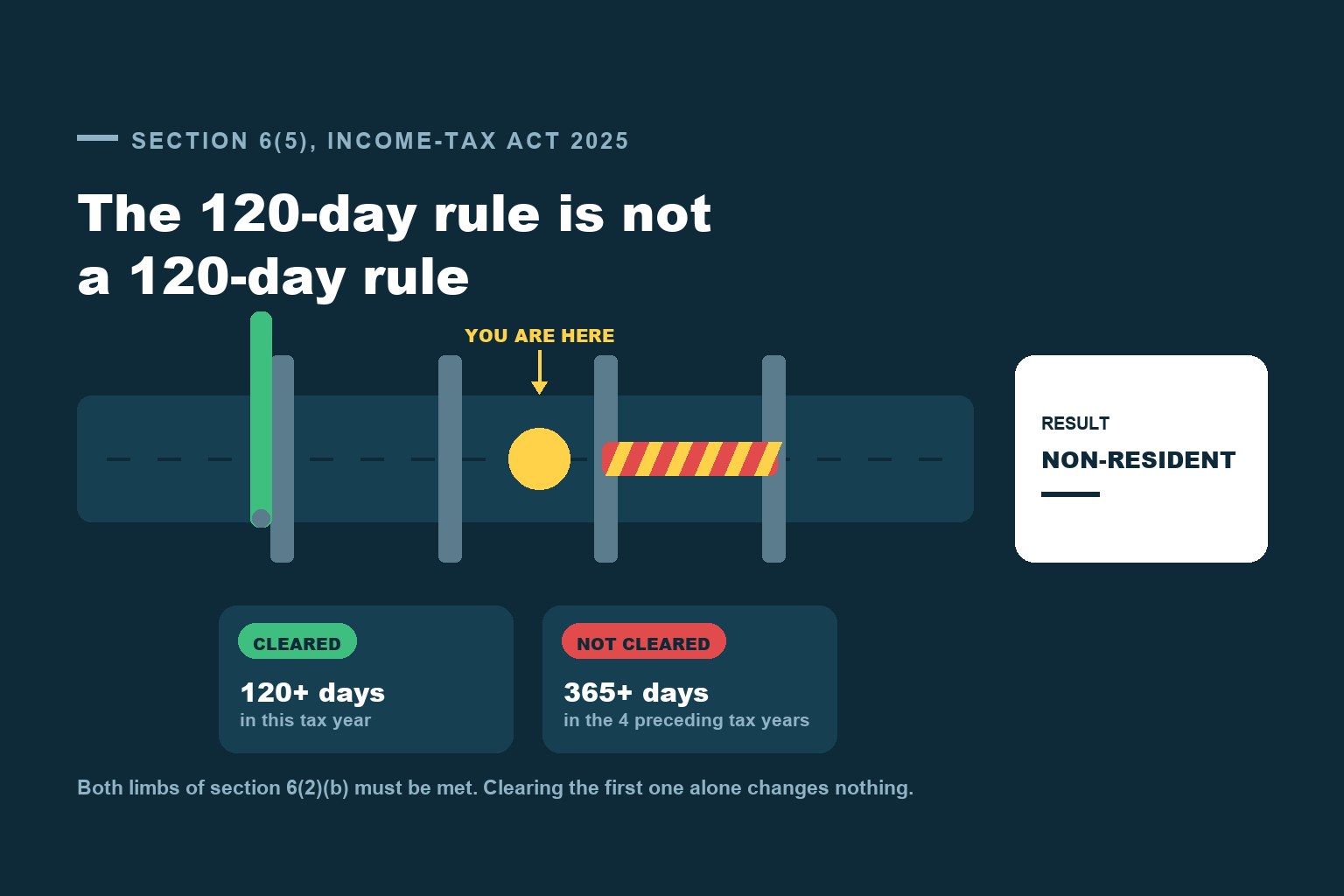

Section 6 of the Income-tax Act, 2025 is under two pages long, and that is the problem — it is short enough that people read it once and believe they have it. Nine things go wrong after that first reading. The biggest: the famous 120-day rule is not a 120-day threshold at all. Section 6(5) substitutes "one hundred and twenty days" for "sixty days" inside section 6(2)(b), and section 6(2)(b)'s other limb — 365 days or more across the four preceding tax years — survives untouched. A visiting NRI with high Indian income who spends 150 days here and has barely been to India in the last four years is not resident, whatever the 120-day headline suggests. Close behind: neither the Act nor the Rules define what "a day" is, and the tribunals have gone both ways on whether your arrival day counts. And deemed residence under section 6(7), the provision Gulf-based Indians worry about most, cannot apply to anyone who is already resident and always lands you in the not-ordinarily-resident box — which means it never taxes your worldwide income.
1. You may be applying the right test from the wrong Act
Two residence tests are live at this moment, and which one you need depends on what you are doing, not on today's date.
If you are filing or revising the AY 2026-27 return — income of FY 2025-26 — residential status is decided under section 6 of the Income-tax Act, 1961. The 2025 Act commenced on 1 April 2026 and applies to income earned from that date onwards; it does not reach backwards into FY 2025-26. (We have set out the transition in detail separately, including what the savings clause preserves.) The due dates for AY 2026-27 differ by category of assessee — and the belated and revised routes, with what each costs, are set out in our separate piece on late filing; this article is about the residence test rather than the calendar.
If you are planning travel, or working out where you will land for the year now running — 1 April 2026 to 31 March 2027, which is Tax Year 2026-27 — the governing provision is section 6 of the Income-tax Act, 2025.
The substance of the two tests is the same. The numbering is not, and neither is the drafting technique, which matters more than it sounds (see section 11 below). One thing worth recording, because it is easy to assume otherwise in a year with a Finance Act in it: section 6 of the 2025 Act was not amended by the Finance Act, 2026. The Department's site serves two versions of the provision, tagged 2025 and 2026; they are word for word identical.
2. The 120-day rule is not a 120-day rule
This is the error that changes the most returns, and almost every summary of section 6 in circulation carries it.
Start with the two basic tests in section 6(2). An individual is resident if he:
- (a) "is in India for a total period of one hundred and eighty-two days or more in that tax year"; or
- (b) "is in India cumulatively for sixty days or more during that year and has been in India cumulatively for three hundred and sixty-five days or more in the four years preceding such tax year".
Note that (b) is a conjunctive, two-limb test. Sixty days this year on its own does nothing. You need the sixty days and the 365 days across the four preceding years.
Now bring in the visitor rules. Section 6(4) says that section 6(2)(b) "shall not apply" to an Indian citizen or person of Indian origin who, being outside India, comes on a visit to India — subject to section 6(5). And section 6(5) says that where such a visitor has total income exceeding fifteen lakh rupees during the tax year (other than income from foreign sources), "sub-section (2)(b) shall apply as if the words 'sixty days' had been substituted with 'one hundred and twenty days'".
Read that substitution carefully. It replaces one number inside section 6(2)(b). It does not replace section 6(2)(b). The second limb — 365 days or more in the four preceding tax years — is still sitting there, entirely unmodified. So the real test for a high-income visiting NRI is:
in India for 120 days or more in this tax year, AND in India for 365 days or more across the four preceding tax years.
A worked example, because this is where the money is:
- An NRI who has lived in Singapore for nine years visits India for 150 days in Tax Year 2026-27 to look after a parent.
- Her Indian rental and interest income, net of everything, is Rs 22 lakh — comfortably over the fifteen lakh threshold.
- Across TY 2022-23 to TY 2025-26 she was in India for 40, 25, 30 and 35 days — a total of 130 days.
Every summary that describes section 6(5) as "a 120-day rule" says she is resident: 150 is more than 120. She is not. She fails section 6(2)(a) (150 is under 182) and she fails section 6(2)(b) as modified, because 130 days is nowhere near 365. She is a non-resident for the year.
The mirror image of the mistake is just as costly: someone who has been in and out of India constantly for work, accumulating well over 365 days across four years, can be pulled into residence by a 120-day visit, or a 60-day one if the fifteen lakh threshold is not crossed. Those are the people who should be counting most carefully, and they are usually the ones told they are safe up to 182 days.
One more consequence of reading the substitution properly. Section 6(3) and section 6(4) both say section 6(2)(b) "shall not apply" — to the Indian-ship crew member and the citizen leaving for employment abroad in the first case, and to the citizen or PIO on a visit in the second. That is a cleaner piece of drafting than the 1961 Act's Explanation 1, which substituted "one hundred and eighty-two days" for "sixty days" instead. Both produce the same outcome, and it is worth seeing why: substituting 182 into the second test makes it "182 days this year and 365 days across four years", which is strictly narrower than the first test's bare 182 days — so the second test can never do any work. Disapplying it says the same thing more honestly. If you have ever wondered why the "60 becomes 182" line never seemed to change any answer, that is why.
3. Nobody has defined "a day", and the tribunals disagree
Section 6 turns entirely on counting days. Neither the Income-tax Act, 2025 nor the Income-tax Act, 1961 defines a day, sets a minimum number of hours, or says whether your arrival and departure days count. Neither do the Income-tax Rules, 2026.
Into that silence, two lines of authority have grown, and they conflict:
- Both days count. In P. No. 7 of 1995, In re [1997] 223 ITR 462 (AAR), the Authority for Advance Rulings held that the day of arrival and the day of departure are both days spent in India.
- The arrival day is excluded. The Bangalore bench in Manoj Kumar Reddy [2009] 34 SOT 180 and the Ahmedabad bench in Pradeep Kumar Joshi v. ITO [2021] 133 taxmann.com 283 both excluded the date of arrival, reasoning from the General Clauses Act principle that the first day in a series is excluded where the word "from" is used.
Three things follow, and none of them is "pick the one you prefer".
First, an advance ruling binds only the applicant who sought it, the transaction it was sought on, and the tax authorities in that applicant's case. For anybody else it is persuasive authority that may be cited, not binding precedent — and the same is true of a tribunal order from a different bench on different facts. There is no settled law here, and no High Court ruling squarely on the point.
Second, the two positions can differ by a material number of days. Someone who makes twelve trips to India in a year is separated by twelve days between the conservative count and the aggressive one — which is the entire gap between 170 and 182.
Third, and practically: count both days. If the conservative count leaves you comfortably on the right side of every threshold, you have no issue to think about. If the conservative count crosses a threshold and the aggressive count does not, you are not doing arithmetic any more — you are taking a position, and it needs to be documented as one, with the travel evidence filed to support it, before the return goes in rather than after a notice arrives.
This is also why a residency working should be a full travel calendar — arrival date, arrival port, departure date, departure port, days in India per trip — rather than a count of passport stamps. Stamps are an incomplete record at the best of times, and are becoming more so: e-gates, biometric entry and exit, automatic Schengen processing, Australian SmartGates and emailed digital entry receipts all produce a crossing with no ink in a passport. Multiple passports make it worse. Keep the boarding passes, the tickets, the visa and residence-permit records, and any employer travel log; they are what a calendar is reconstructed from when the stamps are not enough.
4. Coming home for good is not "coming on a visit"
Section 6(4) is conditional on two things, and the second gets skipped. The individual must be (a) a citizen of India or a person of Indian origin, and (b) a person "who being outside India, comes on a visit to India in any tax year".
Those words do work. Someone who winds up a job abroad, ships their belongings, and relocates to India permanently has not come on a visit — they have come home. The concession in section 6(4) and the 120-day variant in section 6(5) are not available to them. What applies is bare section 6(2)(b): 60 days in the tax year plus 365 days across the four preceding tax years.
For a returning NRI in the second half of a financial year that is a live risk. Land in India in January to stay, and you will not clear 60 days by 31 March unless you arrive by the very end of the month — but the four-year look-back often does clear 365 days for someone who has been visiting family regularly. The year of return is the year to model, not assume.
The same words, with the same effect, sit in Explanation 1(b) to section 6(1) of the 1961 Act for anyone still working on an earlier year.
5. The Rs 15 lakh test does not measure Indian income
Both the visitor rule in section 6(5) and the deemed-residence rule in section 6(7) turn on total income "other than the income from foreign sources" exceeding fifteen lakh rupees. That phrase is routinely shortened to "Indian income", and the shortening is wrong in a way that costs people the threshold.
Section 6(14) defines the term:
"income from foreign sources" means the income, which accrues or arises outside India (except income derived from a business controlled in or a profession set up in India) and which is not deemed to accrue or arise in India.
So the basket you are measuring is total income minus foreign-source income, and foreign-source income is defined narrowly. Two categories of income that arise entirely outside India nonetheless fall inside the fifteen lakh basket:
- Income derived from a business controlled in, or a profession set up in, India — expressly carved out of the definition. A consultancy run from India that bills overseas clients is producing income that counts towards the threshold even though it accrues abroad.
- Income deemed to accrue or arise in India — the deeming provisions catch a range of payments made by non-residents in connection with Indian business or property.
Two further points of precision on the same sentence. It says total income, which is a computed figure — after the deductions the Act allows — not gross receipts, so the working has to be done, not estimated from bank credits. And the threshold is exceeding fifteen lakh rupees: at exactly Rs 15,00,000 you are under it.
6. Deemed residence is narrower than its reputation, and far less dangerous
Section 6(7) is the provision that generates the most anxiety among Indians working in jurisdictions with no personal income tax. Most of that anxiety is misplaced, and the reason is in the two sub-sections either side of it.
First, what it actually requires. An individual is deemed resident only if all three conditions are met:
- he is a citizen of India — a person of Indian origin who is not a citizen is outside this provision entirely, and so is an OCI cardholder who has taken foreign citizenship;
- he is not liable to tax in any other country or territory due to his domicile, residence, or similar criteria; and
- he has total income exceeding fifteen lakh rupees during the tax year, other than income from foreign sources.
The second condition is the one that is misread, because "liable to tax" is a defined term. Section 2(66):
"liable to tax", in relation to a person and with reference to a country, means that there is an income-tax liability on such person under the law of that country for the time being in force and shall include a person who has subsequently been exempted from such liability under the law of that country.
That closing limb decides real cases. If a country's law imposes an income-tax liability and then exempts you from it, you are liable to tax there, and section 6(7) cannot touch you. It is only where no such liability exists under the law at all that the condition is satisfied. The question is therefore about the other country's statute book, not about whether you happen to write a cheque.
Now the two limits, which are the part almost nobody quotes:
- Section 6(8): "Sub-section (7) shall not apply to an individual, who is resident in India for a tax year under sub-sections (2) to (6)." Deemed residence is a residual provision. It catches people the day-count tests have already let go; it never stacks on top of them.
- Section 6(13)(c): a citizen of India who is deemed resident under section 6(7) is not ordinarily resident. Always. There is no route by which a deemed resident becomes ordinarily resident.
And that second point is the whole answer to the worry. Under section 5(1)(c), a resident's foreign income is brought to tax — but where the person is "not ordinarily resident", such income is included "only when it is derived from a business controlled in or a profession set up in India". So a deemed resident is taxed on income received or accruing in India, income deemed to accrue in India, and foreign income from an India-controlled business or profession. Deemed residence does not produce worldwide taxation. A salary earned and received abroad, foreign bank interest, foreign dividends, gains on foreign shares — none of it comes into the Indian net through section 6(7).
7. "Person of Indian origin" is narrower than the card in your drawer
PIO status decides whether the visitor concession in section 6(4) is available to a non-citizen at all, and people reach for the wrong definition — usually the one attached to their OCI card, which is an immigration document governed by an entirely different set of rules.
The tax definition is section 2(78) of the Income-tax Act, 2025:
"person of Indian origin" means an individual who or either of his parents or any of his grand-parents, was born in undivided India.
Three things follow:
- It stops at grandparents. A great-grandparent born in undivided India does not make you a PIO for section 6. Third-generation diaspora are frequently outside this definition while holding an OCI card that suggests otherwise.
- Spouses are not included. The OCI scheme extends to spouses of Indian citizens and OCI cardholders; section 2(78) does not. A foreign national married to an Indian citizen is not a PIO on that basis.
- "Undivided India" is wider than India. Birth in territory that is now Pakistan or Bangladesh counts, because the test is the pre-Partition geography.
A structural note for anyone cross-checking against an earlier year: this is a genuine improvement in the 2025 Act. Under the 1961 Act, Explanation 1(b) to section 6(1) reached the PIO definition by cross-reference to the Explanation to clause (e) of section 115C — a provision inside Chapter XII-A, which deals with investment income of non-resident Indians. The definition was the same; it simply sat somewhere nobody reading section 6 would look. The 2025 Act promotes it into the general definitions, where it applies Act-wide.
8. Seafarers: the rule survived, the rule number did not
The most litigated day-count question in India involves merchant navy crew, and the competing write-ups on residential status tend to leave it out entirely.
Section 6(6) of the 2025 Act provides that for an Indian citizen who is a member of the crew of a foreign-bound ship leaving India, the total number of days in India in respect of that voyage "shall be determined in such manner and subject to such conditions, as may be prescribed". Prescribed where? Rule 8 of the Income-tax Rules, 2026 — notified as part of the new Rules by Notification No. 22/2026 / GSR 198(E).
If you are searching for "Rule 126", stop. Rule 126 of the Income-tax Rules, 1962 was the old home of this provision and remains correct for years under the 1961 Act. For Tax Year 2026-27 onwards, the number is Rule 8.
What Rule 8 does: in respect of an eligible voyage, the period of stay in India excludes the period "beginning on the date entered into the Continuous Discharge Certificate in respect of joining the ship... and ending on the date entered into the Continuous Discharge Certificate in respect of signing off". Two conditions worth holding on to:
- The CDC is the evidence. Not the contract, not the employer's letter, not the ship's log — the dates entered in the Continuous Discharge Certificate, as that term is defined in the Merchant Shipping (Continuous Discharge Certificate-cum-Seafarer's Identity Document) Rules, 2001.
- Only an eligible voyage qualifies. The rule defines it as a voyage by a ship engaged in the carriage of passengers or freight in international traffic, where a voyage originating at an Indian port has a destination outside India, and a voyage originating outside India has an Indian port as its destination. A purely coastal voyage between two Indian ports is not an eligible voyage, and the exclusion does not apply to it.
9. FEMA residence is a different question, and it moves in a different direction
That income-tax residence and FEMA residence are different is well known. What is less well understood is how they differ, because the two definitions are not merely differently worded — they run on different clocks and answer to different tests.
Section 2(v)(i) of the Foreign Exchange Management Act, 1999 defines "person resident in India" as:
a person residing in India for more than one hundred and eighty-two days during the course of the preceding financial year but does not include — (A) a person who has gone out of India or who stays outside India, in either case — for or on taking up employment outside India, or for carrying on outside India a business or vocation outside India, or for any other purpose, in such circumstances as would indicate his intention to stay outside India for an uncertain period...
Two structural differences, both of which matter:
- FEMA looks at the preceding financial year; the Income-tax Act looks at the current one. Your FEMA status for the year you are living through was fixed by where you were last year.
- FEMA's intent carve-outs override its own day count. The 182-day limb is only the opening clause; the exclusions that follow turn on purpose and intention, not on days.
The consequence is that the two statuses can flip in opposite directions on the same facts. The RBI's own worked example is the cleanest illustration available. In A.P.(DIR Series) Circular No. 45 dated 8 December 2003, dealing with Indian students going abroad to study, the RBI concluded that "on both counts viz. their stay abroad for more than 182 days in the preceding financial year and their intention to stay outside India for an uncertain period when they go abroad for their studies, they can be treated as Non-Resident Indians (NRIs)". A student who left India in August is FEMA non-resident straight away — while remaining, on the income-tax day count, very likely resident in India for that whole financial year.
Which status you need depends on the question. Eligibility to open and operate NRE, NRO and FCNR accounts, to hold and transfer assets abroad, and to make overseas investments is a FEMA question, and so is the exemption attached to NRE interest, which is conditioned on the depositor being a person resident outside India under FEMA rather than a non-resident under the Income-tax Act. What is taxable, at what rate, and what you must disclose in the return is an income-tax question. Answering one with the other is how people end up with a correctly-opened NRE account and an incorrectly-filed return, or the reverse.
10. A foreign tax residency certificate settles nothing on its own
Holding a UK residence certificate, a US green card, a UAE tax residency certificate or permanent residence anywhere else does not make you a non-resident of India. Indian residential status is determined only by section 6, on the facts of your presence in India between 1 April and 31 March. No foreign document is an input to that computation.
Where the foreign certificate does its work is one step later. If you are resident in India under section 6 and resident in the other country under its domestic law, you are dual resident, and the applicable Double Taxation Avoidance Agreement's tie-breaker — permanent home, centre of vital interests, habitual abode, nationality, then mutual agreement — allocates treaty residence between the two. That allocation determines which country may tax what under the treaty. It does not rewrite your status under section 6, and you will still be filing in India as a resident, claiming treaty relief on top. The tie-breaker Article differs from treaty to treaty, and it is a question to work through on your own facts rather than by analogy to someone else's country.
11. The old-to-new map, so you can check any earlier working
If you are reconciling a residency working done under the 1961 Act, or reading commentary that quotes the old numbers, this is where each provision went. The substance carried across unchanged unless the last column says otherwise.
| What it does | Income-tax Act, 1961 | Income-tax Act, 2025 | Changed? |
|---|---|---|---|
| 182-day basic test | s.6(1)(a) | s.6(2)(a) | No |
| 60 days + 365 days over four years | s.6(1)(c) | s.6(2)(b) | No |
| Indian-ship crew / employment abroad | Expl. 1(a) to s.6(1) | s.6(3) | Drafting only — the 2025 Act disapplies s.6(2)(b) instead of substituting "182 days" into it. Same result. |
| Citizen or PIO on a visit | Expl. 1(b) to s.6(1) | s.6(4) | Drafting only, as above |
| Visitor with over Rs 15 lakh: 120 days | Expl. 1(b) to s.6(1) | s.6(5) | No — and in both Acts the 365-day limb survives the substitution |
| Seafarer day-count mechanism | Expl. 2 to s.6(1), with Rule 126 of the 1962 Rules | s.6(6), with Rule 8 of the Income-tax Rules, 2026 | Rule number changed; substance identical |
| Deemed residence | s.6(1A) | s.6(7) | No |
| Deemed residence switched off if already resident | Explanation to s.6(1A) | s.6(8) | No |
| HUF, firm, AOP residence | s.6(2) | s.6(9) | No |
| Company residence / place of effective management | s.6(3) | s.6(10) | No |
| Resident for one source means resident for all | s.6(5) | s.6(12) | No |
| Not ordinarily resident | s.6(6) | s.6(13) | No |
| "Income from foreign sources" | Explanation to s.6 | s.6(14) | No |
| "Person of Indian origin" | Expl. to s.115C(e), reached by cross-reference | s.2(78) — a general definition | Same wording, promoted to Act-wide definitions |
| "Liable to tax" | s.2(29A) | s.2(66) | No |
| Scope of total income | s.5 | s.5 | Number unchanged; the NOR carve-out now sits inside s.5(1)(c) |
Two traps in using a table like this. The first is that section numbers collide: section 6 of the 1961 Act, section 6 of the 2025 Act and section 6 of a Finance Act are three different provisions, and a search result that shows you "Section 6" without telling you which Act is showing you a coin flip. The second is that the Department's section pages are versioned archives — the same URL pattern serves several vintages of the same provision, and the one a search engine hands you is often not the current one. Check the Act and the year on the page before you quote it.
12. What a defensible residency working looks like
None of the above is hard. It is just unforgiving, because every threshold is a cliff edge rather than a slope, and the evidence is generated over twelve months but assembled in one afternoon a year later. A working that will survive a question contains:
- A travel calendar for the tax year — arrival date and port, departure date and port, days in India per trip, and a running total — reconciled to tickets and boarding passes rather than to memory.
- The four-year look-back total, computed and shown, not asserted. This is the limb people skip, and it is the limb that decides the 60-day and 120-day cases.
- The day-count convention you used, stated explicitly, with the travel evidence behind it if you departed from counting both arrival and departure days.
- Your citizenship and, if relevant, PIO basis — which parent or grandparent, born where, with the document that establishes it.
- The purpose of each period in India, which is what decides whether section 6(4) is available at all. "Visit" and "return" are different facts with different consequences.
- If the fifteen lakh threshold is anywhere near in play, a computation of total income excluding income from foreign sources, with the section 6(14) exception applied — India-controlled business or profession income included on the correct side.
- Where you land: non-resident, not ordinarily resident, or ordinarily resident, with the sub-section that puts you there named.
Fact patterns that genuinely need a second opinion rather than a spreadsheet: multiple passports or frequent short trips; a year of arrival or departure that straddles 31 March; split payroll or tax-equalised assignments; remote work performed from India for a foreign employer; a business or profession with Indian control and foreign billing; residence claimed in two jurisdictions at once; and anything where the answer changes depending on which day-count convention is applied. In those cases the working is a matrix, not a number, and it should be built before the year ends rather than after the return is due.
This article states the position as at 23 September 2026 and quotes section 6 of the Income-tax Act, 2025 as it stands, unamended by the Finance Act, 2026. Residential status is fact-specific and every threshold in it is a hard edge; confirm the position on your own travel record and income computation before acting on it.

Comments (0)
No comments yet. Be the first to comment!